
EDITORIAL | One year of La Veu Lliure: we came to shake things up
In twelve months, La Veu Lliure has gone from being a new voice to shaping the news agenda, breaking international stories and proving that a different kind of journalism is possible in Andorra


Exactly one year ago, La Veu Lliure was born. We did not launch to occupy one more seat in Andorra’s media landscape. Nor did we come to reproduce the same dynamics, report the same stories or compete for the same scraps of information.
We came to shake things up.
And the first results arrived sooner than even we could have imagined. During our first month, La Veu Lliure’s content surpassed 25 million views on social media. An extraordinary impact for a project that had only just begun in one of Europe’s smallest countries.
But the beginning was not easy.
Part of the traditional media establishment initially chose to ignore or underestimate us. While ministers, politicians, business leaders and other prominent figures began taking an interest in the project, some within the profession appeared convinced that La Veu Lliure would be a passing phenomenon.
It wasn’t.
In an interview with Gabi Fernández, for example, Diari d’Andorra director Ignasi Planell played down our impact. In different programmes and spaces devoted to interviewing media professionals in the country, La Veu Lliure initially did not receive the same consideration as other established outlets, beyond Marc Urgell’s appearance on RTVA during the early stages of the project.
One year later, the landscape looks very different.
When you stop being an anecdote and become the rival to beat
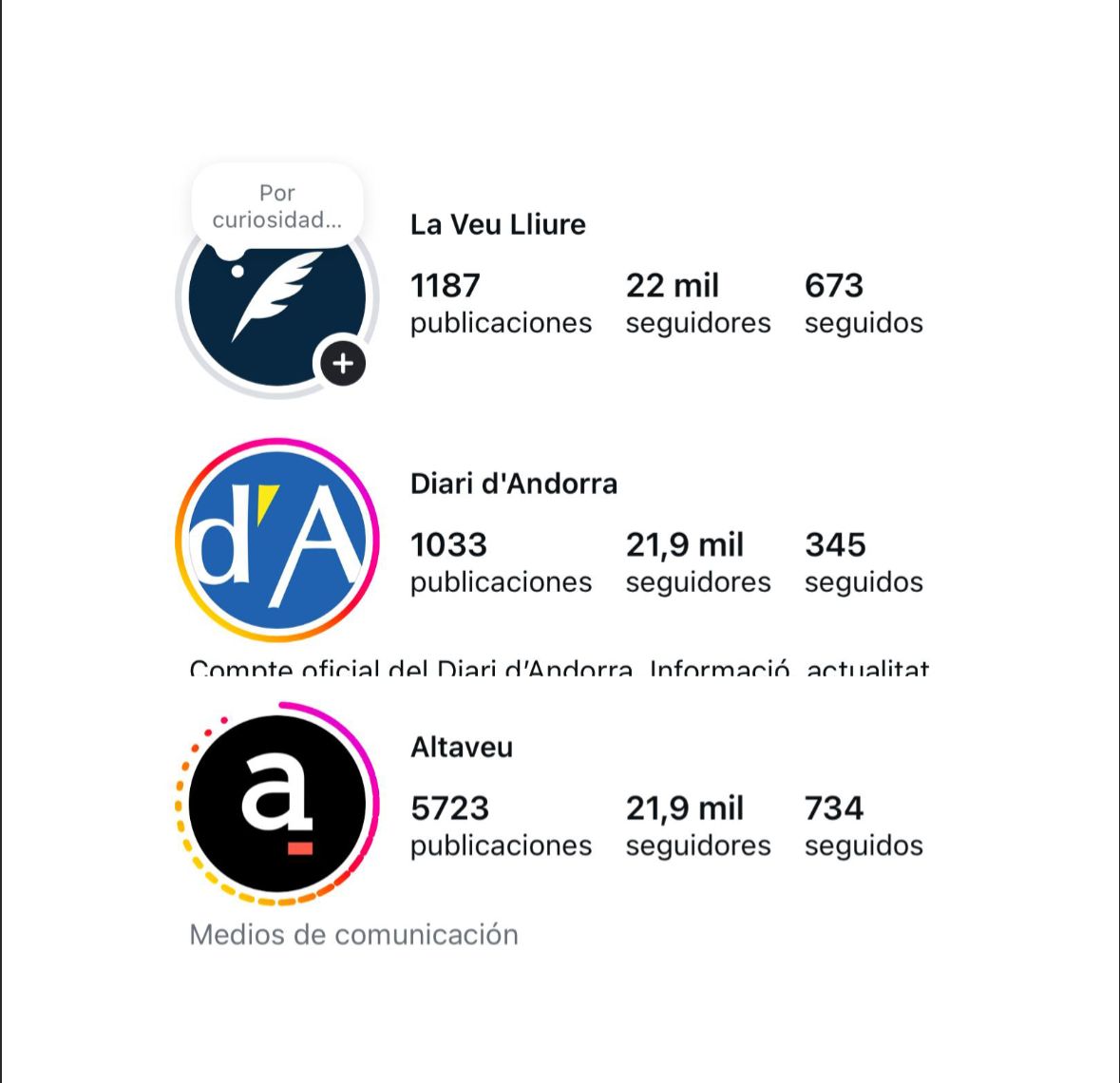
La Veu Lliure reached 22,000 followers on Instagram before any of the country’s main traditional news outlets, proving that a new generation of readers was willing to consume Andorran news in a different way.
But the numbers tell only part of the story.
Our greatest achievement has been something else: ensuring that many of the debates now dominating Andorran politics first passed through our pages.
We have done it with the Association Agreement with the European Union. With immigration. Abortion. Housing. The economy. Taxation. Andorra’s international relations.
We have not limited ourselves to reporting what had happened.
We have tried to explain what was about to happen.
And perhaps no story better sums up our understanding of journalism than the EU Association Agreement.
When much of the public debate was still focused elsewhere, La Veu Lliure reported months in advance that the Association Agreement would have mixed-agreement status. We did so based on sources, statements and information from European institutions.
Official confirmation came later.
By then, the story was no longer merely an Andorran news story. It had crossed borders and gained attention in Spain, France and Italy, because it directly affected the European ratification procedure for an international agreement.
This is the kind of journalism we wanted to practise when we started.
Not waiting for the press release.
Not waiting for someone else to publish first.
Not waiting for an institution to decide when information is allowed to become news.
Ask. Search. Verify. Break the story.
Andorra can interview the world too
During our first year, we also wanted to break through another barrier: the idea that an Andorran media outlet must necessarily limit its reach to the Principality.
La Veu Lliure has interviewed diplomats, business leaders, economists, politicians and internationally recognised figures.
We have spoken with the Russian ambassador, Spanish institutional representatives, entrepreneurs and creators, figures such as Gerard Piqué, and economists such as Miguel Anxo Bastos, among many other people who would rarely have featured regularly on the Andorran media agenda.
We also reported ahead of many others on business and digital phenomena that would eventually become major talking points beyond our borders.
All of this reflects a conviction that remains unchanged after twelve months: Andorra is small; its journalism does not have to be.
Competition forces everyone to improve
The arrival of a new competitor is always uncomfortable.
That is normal.
For decades, Andorra’s media landscape has been dominated by a handful of outlets with established structures, contacts and positions. La Veu Lliure arrived without that legacy and without asking for permission.
And that is probably one of the best things that could have happened to us.
Because competition is healthy.
When one outlet publishes an exclusive, it forces others to react. When a journalist asks an uncomfortable question, it pushes others to ask another one. When a newsroom investigates a document, it forces everyone else to take a closer look.
We do not claim to be infallible. We will make mistakes. Like any newsroom.
But it is difficult not to notice that, while we were being questioned simply because we were new, outlets with decades of experience continued to publish errors, confuse locations, refer to the Head of Government as the “CEO of Sex”, or issue corrections to stories that should have passed the most basic editorial checks.
The age of a newspaper does not automatically make its journalism better.
And being a young media outlet does not condemn it to irrelevance.
Ultimately, the reader decides.
Sources are not inherited: they are built
We have also learned another lesson over the past year.
Having good sources is not simply about receiving leaks from the same institutional circles that have traditionally supplied the country’s newsrooms.
Sources are built.
In Brussels. Madrid. Paris. Barcelona. Inside the Government. In the opposition. Among business leaders. Diplomats. Civil servants. Lawyers. Economists. Workers. Residents.
This network has enabled us to publish information that would have been almost impossible to obtain simply by waiting for an official statement.
And it is probably one of the assets we are most proud of.
Because an exclusive is not a sensational headline.
An exclusive is when someone trusts you with information that nobody else knows yet.
Journalism in more than one language
We also decided that linguistic borders would not limit our audience.
Catalan is and will remain an essential language for La Veu Lliure and for the country we report on. But we have also published in Spanish and English, because when a story from Andorra has international significance, there is no reason to wait for foreign media to tell it to the world.
We want a story published in Andorra to be read directly from Madrid, Brussels, Paris, London or any other capital.
Without intermediaries.
One year later
They ignored us.
Then they watched us.
Then they criticised us.
And eventually, they had to compete.
That is probably the best summary of our first anniversary.
La Veu Lliure has not come this far because we have more history than anyone else. Quite the opposite: we have less history than almost all of them.
We got here because we ran.
Because we asked questions.
Because we looked for sources beyond the usual circles.
Because we understood social media as a public square rather than simply a shop window for posting links.
Because we took editorial risks.
And because we have never accepted that something having “always been done this way” is sufficient reason to keep doing it the same way.
One year later, we can look back and remember those first days when some thought this would not last.
Today, we are no longer concerned about whether people take us seriously.
We are concerned about what we will publish tomorrow.
Anniversaries are an opportunity to look back, but La Veu Lliure was not created to contemplate what had already happened.
It was created to get there first.
And that is exactly what we will continue trying to do.
Thank you to everyone who has read us, shared our stories, criticised us, leaked information to us, granted us an interview or trusted us with a story during these first twelve months.
And thank you, too, to those who thought we would not last.
You gave us one more reason to keep going.