
Landry Riba acknowledges EU Free Movement Directive will apply to Andorra under the Association Agreement
The Secretary of State confirms that Directive 2004/38 is included in Annex VIII


Andorra’s Secretary of State for Relations with the European Union, Landry Riba, has confirmed that Directive 2004/38/EC on the free movement and residence of EU citizens and their family members forms part of the Association Agreement between Andorra and the European Union and will therefore apply to the Principality under the terms and specific adaptations negotiated in the agreement.
Riba made the statement on Wednesday on X: “Directive 2004/38 forms part of Annex VIII of the Agreement.” The Secretary of State also stressed that Article 85.2 of the Association Agreement establishes that its provisions must be interpreted and applied in accordance with the case law of the Court of Justice of the European Union (CJEU).
“Therefore, yes, the Association Agreement is what regulates these matters,” Riba concluded.
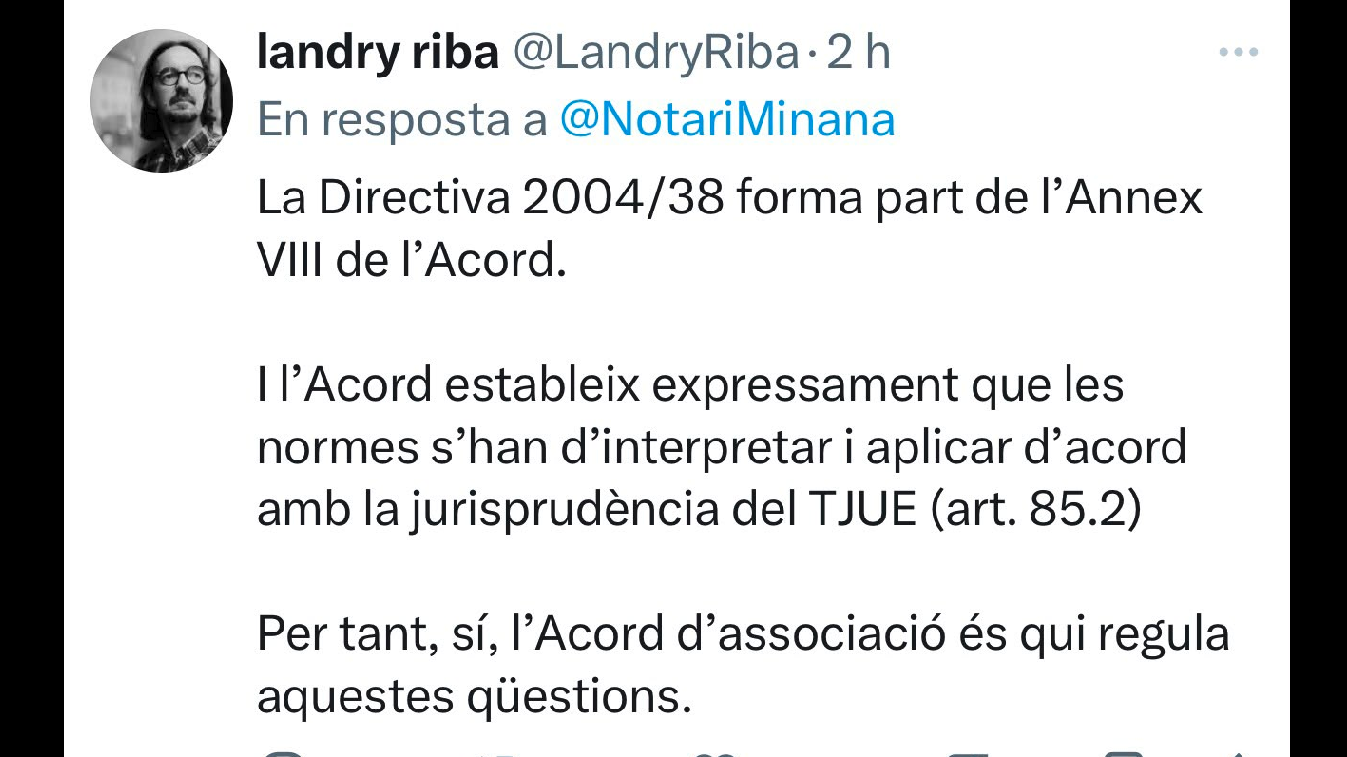
Official European documentation confirms this point. A joint declaration by the EU and Andorra on the free movement of persons expressly states that Directive 2004/38/EC will apply in relations between the EU and Andorra, in accordance with the terms and conditions laid down in Annexes VIII and V of the Andorra Protocol.
What does Directive 2004/38 mean for Andorra?
The EU directive regulates the rights of entry, residence, exit and equal treatment of EU citizens and their family members. However, its incorporation into Andorra's legal framework is not without limitations. Annex VIII introduces several specific adaptations negotiated by the Principality, particularly regarding immigration quotas.
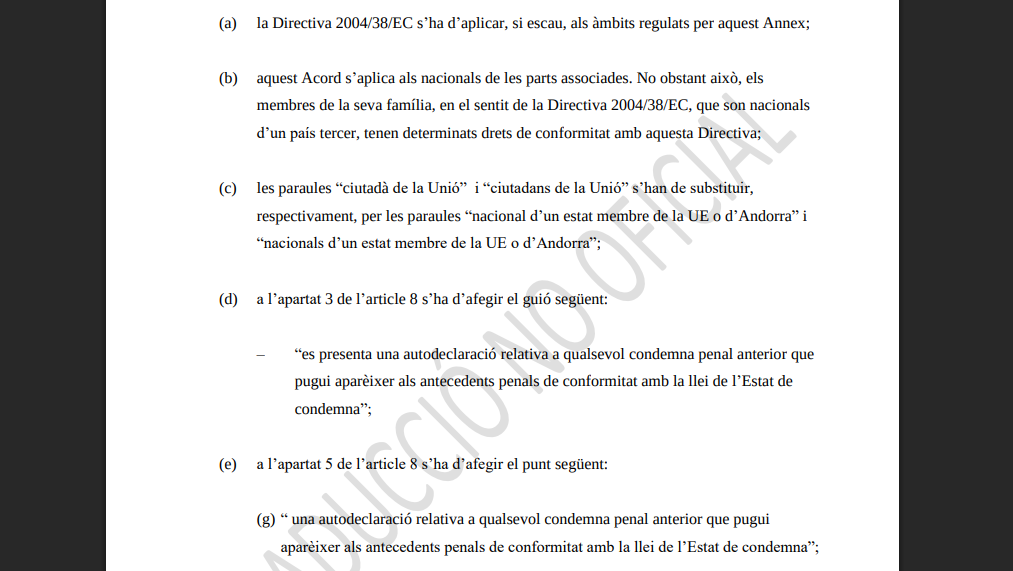
Among other provisions, the agreement establishes that EU citizens will not require a residence permit for stays of less than three months, provided that they do not take up employment or another permanent economic activity during that period. For longer stays, residence permits and the specific limitations established for Andorra will continue to apply.
Annex VIII also establishes the controversial quota system. For EU citizens carrying out an economic activity, the number of new long-term permits available each year must allow for a net annual increase of no less than 7% of the average number of valid residence permits over the previous five years. For economically inactive EU citizens, the minimum rate will be 2.5%.
However, the rules go beyond immigration quotas.
Family members of EU citizens legally residing in Andorra will be entitled to obtain a permit with the same period of validity as that of the family member on whom they depend. Furthermore, if they wish to take up an economic activity, the fact that the annual quota for EU workers has been exhausted cannot be used as grounds to deny them a residence permit.
Directive 2004/38 also regulates the right of permanent residence. Annex VIII expressly provides for the application in Andorra of Chapter IV of the directive, which generally provides for the acquisition of permanent residence rights after five years of continuous legal residence, subject to the conditions and adaptations established for the Principality.
EU case law will also carry weight
Riba's confirmation is particularly significant because the agreement does not merely incorporate the text of the directive. The Association Agreement itself establishes mechanisms requiring its interpretation to take into account the case law of the CJEU.
The joint declaration negotiated between Andorra and the EU expressly notes that European case law provides criteria on issues such as the measures that the host state may adopt to preserve public order or expel foreign nationals.
At the same time, it recognises Andorra's geographical, demographic and social specificities when interpreting certain matters relating to security and public order.
In short, Riba's remarks confirm that Directive 2004/38 is incorporated into the legal framework of the Association Agreement and that the rights relating to free movement, residence and family reunification covered by the directive will have to be applied under the terms agreed between Andorra and the European Union.
Comments
Els comentaris son de…
Els comentaris son de retrasats, la lliure circulacio es quelcom que beneficiarà els treballadors dl pais
mirad como esta españa…
mirad como esta españa aprended de los vecinos, aun estais a tiempo de conservar la tranquilidad del pais, que por cierto me encanta.
Me la tallo abans de votar si.