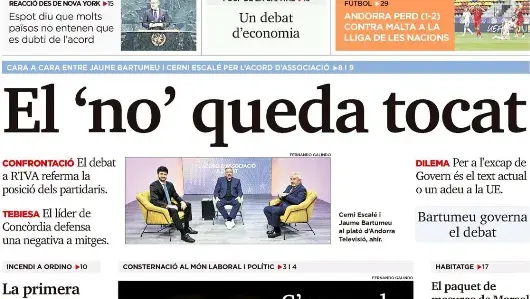
EDITORIAL | A Legal Vacuum Andorra Cannot Afford
Editorial Board


In its final signed version, the EU–Andorra Association Agreement has become an agreement between the European Union, each of its 27 Member States, Andorra and San Marino.
That makes 30 signatory parties in total. According to this interpretation, the Association Agreement can only enter into force once it has been ratified by the relevant national parliaments — and regional parliaments where applicable — of all 30 parties. A single rejection by one of the 30 parties could prevent the agreement from entering into force.
Given that the ratification process across all 30 parties could take ten years or more, the Association Agreement provides for provisional application.
The Risks of Provisional Application
Provisional application is a legal mechanism that, from the date it takes effect for Andorra, would require the Principality to begin incorporating the bulk of nearly 4,000 EU directives and regulations into its legal system.
Under the scenario examined here, Andorra would also have to terminate key existing agreements, including the Customs Union Agreement (Article 4 of the Andorra Protocol), as well as other bilateral arrangements such as the 2004 Cooperation Agreement, the 2004 Savings Taxation Agreement and the trilateral agreements involving Spain, France and Portugal.
The legal vacuum could arise if Andorra were to begin provisional application of the Association Agreement while awaiting ratification by the 27 EU Member States, only for one of their national or regional parliaments to reject the agreement several years later.
In that scenario, Andorra could find itself having incorporated a substantial body of EU legislation into its domestic legal framework while having lost its existing customs, taxation, cooperation and trilateral agreements — and without an Association Agreement ultimately entering into force.
The Government's Roadmap and Its Potential Consequences
This risk becomes particularly relevant when considering the sequence of events envisaged under the Government's political roadmap.
- First, Andorra would hold general elections in March or April 2027.
- Second, the new Head of Government could request, with the support of the General Council, that the Co-Princes call a referendum on the Association Agreement. Whether such a referendum takes place would depend on the political decisions of the next government, since the referendum commitment made by the current Head of Government has not yet been fulfilled.
- Third, if the referendum produced a majority in favour of the agreement, or if no referendum were held, the text would proceed to the General Council, where its ratification would require the support of at least two-thirds of its members.
- Fourth, once Andorra had ratified the agreement, the Government would face two possible paths. It could defer depositing its instrument of ratification in Brussels until the 27 EU Member States had completed their own procedures, allowing the agreement to enter into force without provisional application. Alternatively, it could deposit Andorra's ratification and request provisional application.
Fifth, under the provisional-application scenario outlined in this editorial, Andorra would begin a two-year period to incorporate the bulk of the nearly 4,000 EU directives and regulations while activating the replacement or termination of existing agreements, including the Customs Union Agreement, the Cooperation Agreement, the savings taxation arrangements and the trilateral agreements.
Finally, the parliaments of the 27 EU Member States would continue their ratification procedures according to their own political and institutional calendars. This process could take a decade or longer, and the composition of the parliaments voting on the agreement several years from now cannot be predicted.
If all the necessary ratifications were obtained, the Association Agreement could enter into force definitively.
But what would happen if one national or regional parliament rejected it after Andorra had already begun provisional application?
That is the central question.
The concern is that, by the time a rejection occurred, Andorra might already have dismantled or replaced the legal agreements governing important parts of its relationship with the European Union and neighbouring countries.
Under the scenario described, the Customs Union Agreement, the Cooperation Agreement, the savings taxation arrangements and the trilateral agreements could already have ceased to apply.
If the Association Agreement subsequently failed to enter into force, Andorra could face a serious legal vacuum, with no automatic guarantee that the previous arrangements would be restored.
The Principality could then be forced into another complex negotiation with the European Union to recover legal and economic arrangements it had previously enjoyed.
For a small state whose economy and international relations depend heavily on legal certainty and stable agreements, such an outcome would represent a risk that cannot simply be dismissed.
It is impossible today to calculate with any confidence the probability that one of the parliaments involved in the European ratification process might reject the Association Agreement.
No one can predict the political composition of those institutions three, four or ten years from now.
However, European history shows that the ratification of mixed agreements can encounter serious political obstacles.
In 2020, the Cypriot parliament rejected the ratification of the Comprehensive Economic and Trade Agreement (CETA) between the European Union and Canada, amid concerns involving the protection of Halloumi cheese.
Similarly, in 2016, opposition from the Belgian region of Wallonia delayed the signing of CETA, largely because of concerns surrounding its investment protection mechanisms.
Both episodes demonstrated how individual national or regional political decisions can complicate the approval of international agreements negotiated at European level.
They also illustrate the institutional uncertainty that can arise when agreements require approval from numerous parliamentary bodies.
The EU–Andorra Association Agreement is not identical to CETA, and the legal consequences of a failed ratification would depend on the applicable treaty provisions. Nevertheless, these precedents show why the political risks associated with mixed agreements deserve serious consideration.
The complexity of the Association Agreement, its mixed nature and the requirement for ratification by multiple European parliaments create a situation in which provisional application could expose Andorra to considerable legal uncertainty.
If existing agreements were terminated before the Association Agreement entered into force definitively, the country could face a difficult negotiating position should the ratification process ultimately fail.
The resulting negotiations with Brussels could be exceptionally complicated, particularly given Andorra's limited bargaining power compared with the European Union.
This is why the debate can no longer be reduced to a simple choice between supporting or rejecting the Association Agreement.
The real question has become considerably more complex:
Should Andorra accept an Association Agreement that could be provisionally applied for years, only to face rejection by one of the 27 EU Member States and potentially leave the Principality in a legal vacuum?
The final wording of the Association Agreement introduces an additional dimension to this debate.
Article 112(2) provides for the possibility of provisional application of the entire agreement or only part of it.
This distinction is crucial.
It means that the discussion should not concern only whether the Association Agreement should be approved, but also which provisions would be applied provisionally and what legal consequences would follow from each option.
Would Andorra accept full provisional application? Would it prefer partial application? Which existing agreements would be affected? And what safeguards would exist if the European ratification process failed?
These questions should form part of any serious political and public debate, including a potential referendum or parliamentary decision.
The implications are enormous.
The Association Agreement is a complex legal instrument that offers Andorra a path towards closer integration with the European single market.
But its potential advantages must be weighed against the risks associated with provisional application and the uncertainty of a lengthy ratification process.
The central concern is not merely whether the agreement should be approved, but whether Andorra could find itself having relinquished existing legal arrangements without securing a definitive replacement.
The possibility of full or partial provisional application, combined with the risk of a subsequent rejection by one of the required parliamentary bodies, raises fundamental questions about legal certainty and the protection of Andorra's national interests.
The Government must explain what would happen in such circumstances, which legal guarantees would protect the Principality and whether existing agreements could be preserved or restored if ratification failed.
Andorra cannot afford to enter a process of such far-reaching consequences without clear answers to these questions.
A legal vacuum of this magnitude is a risk the Principality cannot afford.