
Riba responds to Clavera with a document that does not show Andorra’s customs agreement would end if voters reject the association deal
The Secretary of State cites a European report that discusses renegotiating the customs regime in the context of the single market


Landry Riba, Secretary of State for Relations with the European Union, responded on Tuesday to comments by Alfons Clavera, secretary-general of Andorra Endavant, on whether the customs agreement between Andorra and the European Union would remain in force if voters reject the association agreement.
Clavera argued that the customs agreement would not disappear if Andorra voted against the association deal. Riba shared Clavera’s comments on X from an interview with RTVA, in which Clavera said it was false that the agreement could “go up in flames”. Riba added that the evidence presented should, at the very least, lead people to “qualify that claim”.
As supporting material, the Secretary of State posted links to two news articles and an excerpt from a European report. However, the material he cited does not directly establish that the current customs agreement would be terminated if Andorra rejects the association agreement.

One of the articles, published by Altaveu, does not mention the customs agreement. It discusses France’s position and says that maintaining the status quo would be difficult, according to the article. The other link leads to a piece by El Periòdic that returned a 404 error and could not be read when checked.
Report discusses reviewing the regime in the context of the single market
The excerpt shared by Riba does not identify the report’s source or publication date. In sections 2.39 and 2.40, it examines the relationship between the systems in Andorra and San Marino and the European single market.
Section 2.39 distinguishes between customs systems based on duties collected and those calculated according to population. For Andorra and San Marino, the text suggests that a model based on duties and charges tied to the actual consumption of goods could be preferable, while also taking the tourist population into account.
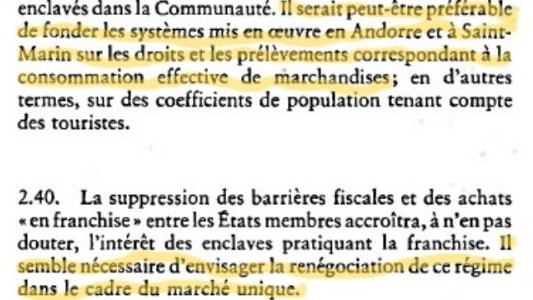
Section 2.40 then says that removing fiscal barriers and duty-free shopping between member states could make enclaves operating under that system more attractive. For that reason, it says renegotiating the regime within the framework of the single market could be necessary.
That reference is the central point in the document cited by Riba. The report discusses whether certain tax and customs regimes are compatible with the functioning of the European internal market. It does not say Andorra would have to renegotiate its customs agreement if voters reject the association deal.
The current customs agreement and access to the single market are separate issues
The current customs agreement between Andorra and the European Union is separate from any potential integration into the single market. The association agreement provides for access to the internal market, while the existing customs regime operates independently of that association.
The report shared by Riba therefore raises the possibility that certain aspects of the regime could be reviewed if Andorra integrates into the single market.
It does not say that a review would be required if Andorra rejects the association agreement. Nor does it expressly state that the current customs agreement would be at risk if the association deal is not approved.
The excerpt also presents an assessment by a European body, not a formal requirement from Brussels addressed to Andorra. Based on the information provided, the document does not show that keeping the current customs agreement outside the single market would force Andorra to renegotiate it, or that the agreement would automatically be lost.
The material released by the Secretary of State thus raises the possibility of a review linked to the single market, but does not prove that Andorra’s customs agreement would end if voters reject the association deal.
Add new comment
Related news


